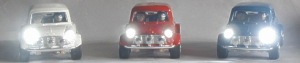
Abstract
Scalextric (in one form or other) have been producing
Scalextric cars
since the late 1950s and over this time several different methods have
been used to provide their models with lights. Head lights, tail
lights, brake lights, Turbo Flash, lights for Marshal’s cars and roof
lights for Police cars.
This article gives a potted history of the lighting methods used throughout the years.
Introduction
Scalextric realised long ago that their Scalextric cars can look more
realistic if the cars were fitted with lights, both headlights and rear
tail lights. The methods used by Scalextric very much follow the
technologies available at the time; bulbs, LEDs and electronics have all
played their role as time has passed.
 Bulbs
Bulbs
The first Scalextric cars to be fitted with lights were the
E range of cars (E1 to E5) produced from 1962. These used one small
bulb for each headlight and one small bulb to illuminate the rear tail lights.
Bulbs were also used for the Marshal’s car, Aston Martin DB4 (E5)
which remained permanently illuminated just like a headlight. The Rover
3500 range of Police cars were fitted with flashing roof lights which
used electrics to switch the bulb on and off. Quite realistic too.
Bulbs were used right up to the introduction of LEDs in the early
2000s as this was the only sensible way to produce white light. In the
mid 1990s some cost cutting starts to kick in and a change takes place
to the method of providing the lights. The new system has one bulb
located in the chassis towards the centre of the car and light guides
illuminate the headlights and tail lights. This solution was both
reliable and more readily serviceable too.
LEDs
As time progressed the method of providing lights in Scalextric cars
remained unchanged until the introduction of brake lights and Turbo
Flash for the Formula 1 models in 1988. The brake lights and Turbo
Flash lights operate in the same way. A small electric circuit senses
that power has been removed from the car (braking) and then switches an
internal power store on, thereby providing power to the rear lights.
For brake lights this was 2
red LEDs and for Turbo Flash this was 1 yellow LED.
Several different Scalextric cars during the early 1990s continued to
use bulbs for headlights, LED for tail lights and LEDs for brake
lights.
The next change was in the early 2000s where Scalextric replaced the
bulbs to LEDs front and rear. Initially the front LEDs were orange
which was not too realistic at all and looked terrible. That was not a
good idea. Soon after the front lights were changed to white LEDs. So
this is where Scalextric are today. White LEDs for headlights and red
LEDs for tail lights.
Once blue LEDs became cost effective in the mid 2000s they were also
used in the Police range of Scalextric cars replacing bulbs for the
flashing roof lights.
The solution that got away
One lighting solution Scalextric never implemented was to
combine the rear LEDs to be both tail lights and brake lighst in one red LED.
Scalextric Car Restorations have achieved this.
While the car is under power on the track each LED emits a moderate
brightness red light ideal for the tail lamps of Scalextric cars. When
the power is released and the car slows down, both the LEDs become much
brighter just like real car brake lights. This is accomplished with a
small electronic module that senses when the car is slowing or stopping.
The module then significantly increases the brightness of the LEDs for a
short period of time.
This LED kit connects to the car with only two wires connected
directly to the car motor making the fitting simplicity itself. The kit
is protected against improper electrical fitting.
General
On the whole
Scalextric has used lighting
to good effect over the years. They basically did the best they could
do with the technologies around them. The only real flaw was the use of
orange LEDs as head lights and the missed opportunity to add combined
brake lights and tail lights.
About the author:
Gary Harding has been working with Scalextric cars for over 35 years
and now operates Scalextric Car Restorations in the UK. Scalextric Car
Restorations is a Worldwide internet based business that offers for sale
high quality Scalextric cars and Scalextric parts from the 1960s to the
present day. All the restoration work is carried out to the highest
standards with the highest quality parts available. Only the best cars
are selected and the final result is a car that is genuinely like new.
Further help and advice relating to this article or Scalextric cars in general can be found at:
http://www.scalextric-car.co.uk